
Across Maryland and Delaware, 181 Acres Permanently Conserved in the Nanticoke Watershed
15-Year Effort Establishes the Henry F. Porter Preserve Across Two States and Expands Chesapeake Forest Lands
Seaford, DE — The Nanticoke River Watershed Conservancy (NRWC), Chesapeake Conservancy and partners today celebrated the culmination of a 15-year conservation effort that crossed state lines and generations of family ownership, permanently conserving 181 acres of forest and wetlands along the Nanticoke River and Wright Creek.
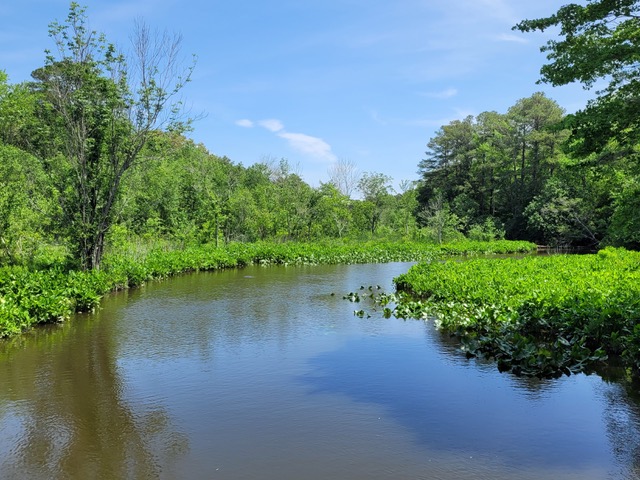
Photo by Ron Vickers
The recently established Henry F. Porter Preserve spans the border between Delaware and Maryland, linking protected lands on both sides of the state lines and strengthening one of the Chesapeake Bay watershed’s most ecologically significant corridors.
A Multiphase, Multigenerational Conservation Effort
NRWC began working to conserve the property more than 15 years ago. The effort involved negotiations with eight descendants of Henry F. Porter and was complicated by deeds and multiple inheritances dating to the mid-1800s. Chesapeake Conservancy later joined the project to help advance acquisition and funding efforts.
To secure these conservation lands, Chesapeake Conservancy purchased the properties on an interim basis while working to transfer the site to long-term conservation ownership. The initial acquisition for the preserve included about 138 acres in Delaware and 39 in Maryland, featuring upland forest, floodplain, old field, tidal creek and more than a mile of Wright Creek shoreline, as well as frontage along the Nanticoke River. Funding for this first step was from Mt. Cuba Center, Chesapeake Conservancy and private donations.
Adjacent to land already owned by the state, the Maryland Department of Natural Resources (MD DNR) was then able to purchase the 39-acre tract with Program Open Space funding, adding it to its Chesapeake Forest Lands, a system that encompasses more than 75,000 acres across six counties. The Maryland tract is managed as a sustainable forest and is leased to a private hunt club.
The next phase involved transferring the 138 acres in Delaware to NRWC. This land is permanently protected by a conservation easement co-held by the Navy and the Delaware Department of Natural Resources and Environmental Control (DNREC). Both agencies contributed funds for the conservation easement through the Delaware Open Space Program and the Department of War Readiness and Environmental Protection Integration Program (REPI). The REPI program provides funding to military services to support cost-sharing agreements to avoid land use conflicts near military installations and ranges, address environmental restrictions that limit military activities and increase military installation resilience.
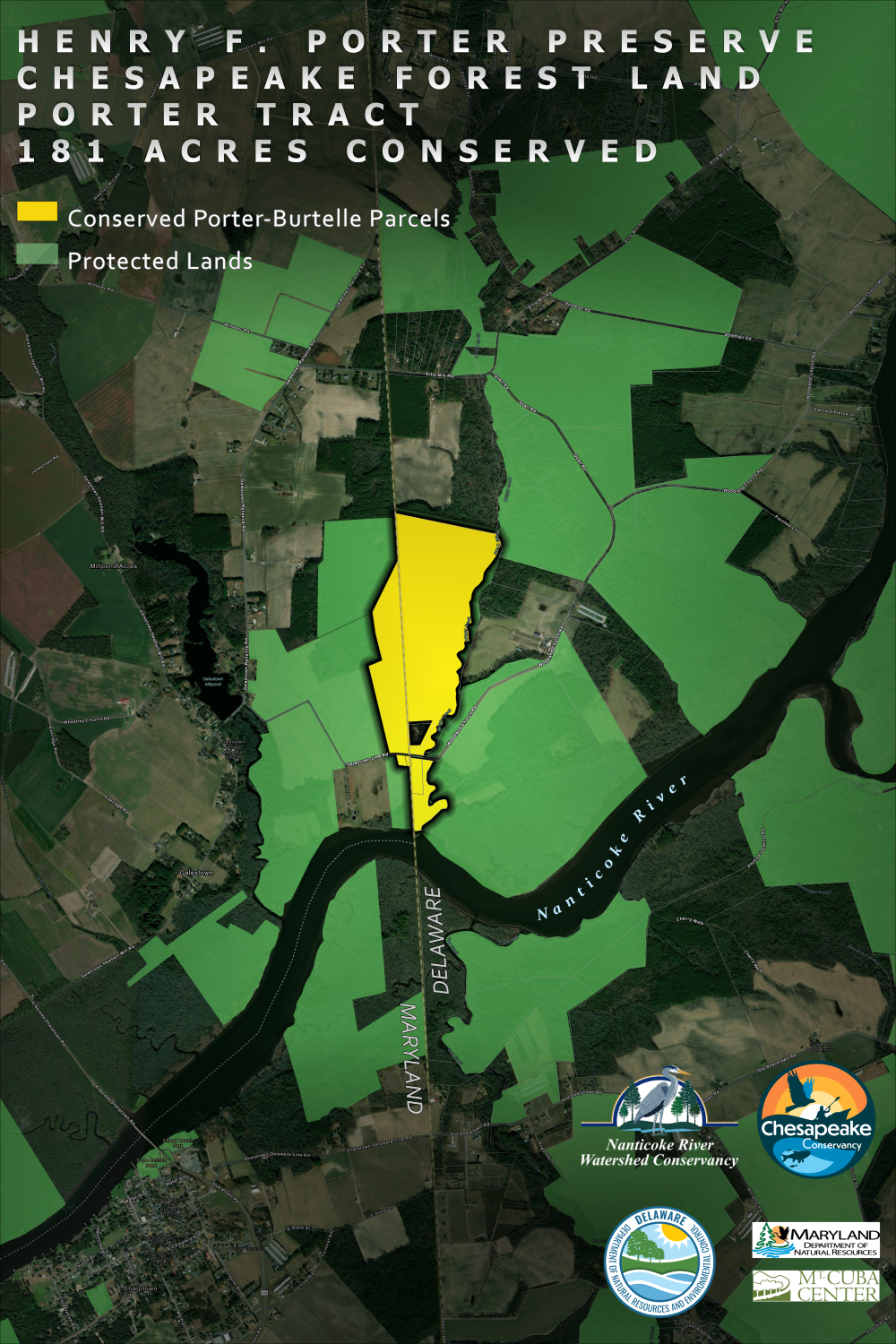
The Delaware portion also borders state-protected lands, including the Nanticoke Wildlife Area and the Pete Gum Preserve near Seaford. Future plans include improving existing logging trails on the property to allow for hiking and nature study.
Just after this transaction, the Porter family worked with NRWC and Chesapeake Conservancy to sell four additional wooded acres along Wright Creek for conservation. Funding for this purchase was from the Mt. Cuba Center.
Honoring Henry F. Porter
To honor Henry F. Porter, who purchased the land in 1950 and was the grandfather of the Porter and Burtelle family members, the 142 acres in Delaware will be known as the Henry F. Porter Preserve, and the 39 acres in Maryland will be known as the Porter Tract of the Chesapeake Forest Lands.
“The Nanticoke River Watershed Conservancy considers it a privilege to have diligently worked for so many years on protecting this precious gift to Delaware and Maryland. We are grateful to the Porter and Burtelle families who were willing to consider conserving their lands, and also to our partners who recognized the ecological importance of this tract and who had faith in us to join in making protection a reality,” said NRWC Executive Director Marlene Mervine. “The important varied habitats contained within this site will protect both the land and its wildlife species and will provide an important recreational source for the citizens of both Delaware and Maryland in perpetuity.”
“Chesapeake Conservancy is proud to partner with the Nanticoke River Watershed Conservancy on this bistate, multigenerational conservation success story. We thank the Porter and Burtelle families for choosing conservation for the future of this land, as well as our private donors, Mt. Cuba Center, REPI and the Delaware and Maryland state partners,” said Chesapeake Conservancy CEO Susan Shingledecker. “This is the 26th property the Chesapeake Conservancy has helped protect in the Nanticoke watershed with support from Mt. Cuba Center, totaling 3,466 acres.”
“The Nanticoke River watershed is one of the Mid-Atlantic’s most vital ecological resources, a landscape where forests, wetlands and tidal waters come together to sustain critical biodiversity,” said Charles Copeland, president of Mt. Cuba Center. “By protecting the Henry F. Porter Preserve, we are helping to safeguard critical habitat for migratory birds, native fish and countless other species that depend on this connected corridor. Mt. Cuba Center is proud to work alongside dedicated conservation partners whose shared commitment makes lasting protection of places like this possible.”
“These parcels lie beneath Navy airspace used for aircraft research, development, test and evaluation, used by Naval Air Station Patuxent River and the Atlantic Test Range, and REPI is one tool that the Navy uses to combat encroachment that can limit or restrict military training, testing and operations, ensuring military readiness in these areas,” said Capt. Mark Zematis, then Naval Air Station Patuxent River Commanding Officer. “The permanent protection of these lands will ensure any development is compatible with operations, expanding protected corridors of land. We thank the Porter and Burtelle families for choosing conservation.”
“This is a perfect example of both the use of Delaware Open Space funds as well as the partnerships that are often needed to conserve large, ecologically significant tracts of natural lands, and DNREC is proud to play a role in it,” Delaware DNREC Secretary Greg Patterson said.
“The Chesapeake Forest Lands comprise some of the last large segments of unbroken forest in the Delmarva region of Maryland, and this 39-acre addition helps further protect this valuable resource,” said Maryland DNR Secretary Josh Kurtz. “Our thanks go to the families for their dedication to preserving these lands, and to our partners for their diligence in bringing this acquisition to fruition.”
“The 181 acres being conserved in the Porter Preserve is a victory for the Nanticoke River watershed, the U.S. Navy, farmers and sportsmen,” said U.S. Senator Chris Coons (D-DE). “As Ranking Member on the Senate Appropriations Subcommittee on Defense, I am a strong advocate for Readiness and Environmental Protection Integration (REPI) Program funding, which made this conservation project possible.”
“The creation of the Henry F. Porter Preserve demonstrates the need for meaningful collaboration to establish a healthy environment. Thanks to the partnership between the Nanticoke River Watershed Conservancy, Chesapeake Conservancy and others, our shared ecosystems will flourish,” said U.S. Senator Lisa Blunt Rochester (D-DE). “More than a decade's work has brought us to this moment. I’m grateful for the Henry F. Porter Preserve, and I’m certain it will benefit generations to come.”
“A healthy Chesapeake Bay watershed is essential for our state’s economy and environment. Although there is still much work to be done, the efforts to establish the Henry F. Porter Preserve and conserve this land are an important example of what partnerships to preserve and clean up the Bay can achieve. We will keep working to deliver federal resources to support the Bay watershed for generations to come,” said U.S. Senator Chris Van Hollen.
Building on Momentum for Landscape-Scale Conservation
“Using advanced mapping and data analysis, Chesapeake Conservancy has identified more than 1,000 additional acres within the Mid-Atlantic Flyway that would provide significant conservation benefit if protected,” continued Shingledecker. “Together with our partners, we will continue to pursue a coordinated approach to landscape-scale conservation in the Nanticoke, widely considered the Everglades of the North.”


